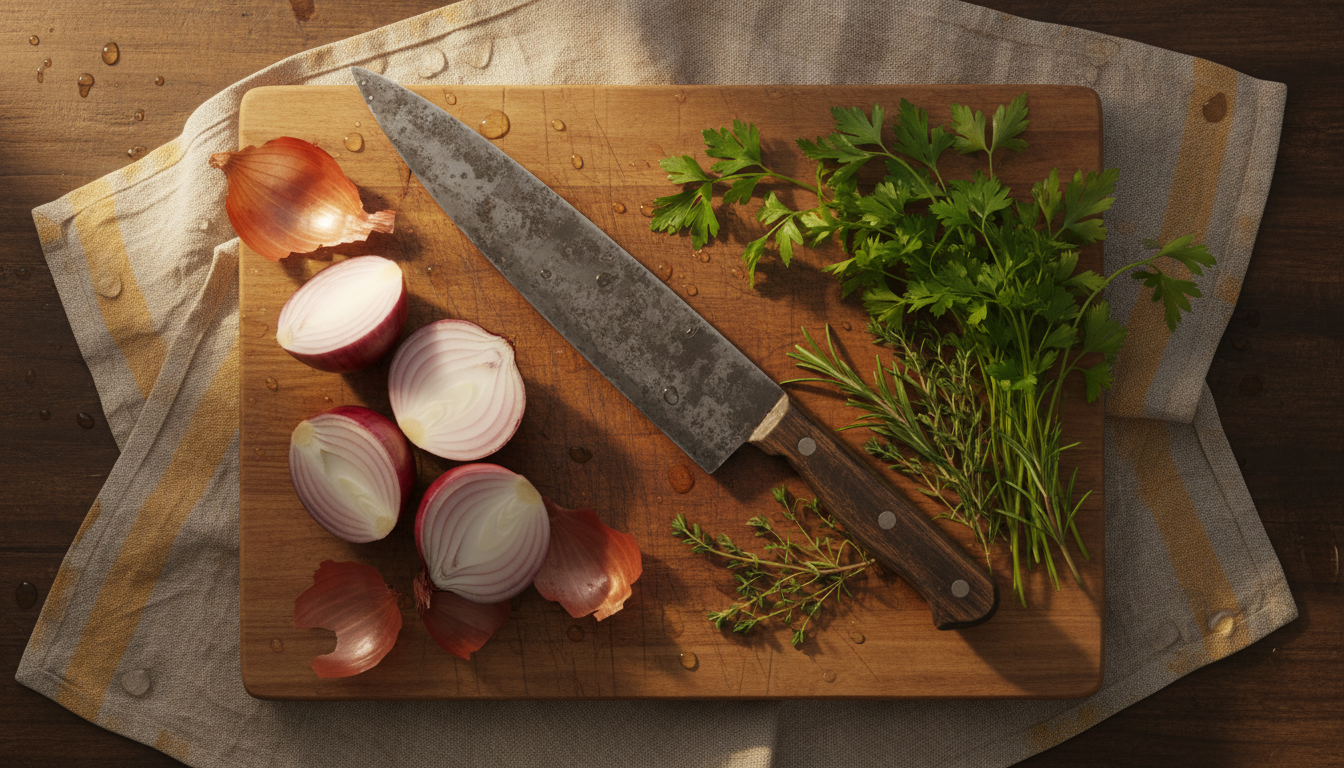
You do not need expensive equipment to cook well, but you do need to cut safely. These seven basics come from university extension programmes that teach home cooks, and every one of them makes prep faster and safer.
1. Cut on a Board, Not a Plate
University of Illinois Extension says to cut on a cutting board, not on a plate or the countertop. Utah State University Extension adds that wood or plastic boards are gentler on knife edges than hard surfaces such as glass.
2. Stop the Board From Sliding
Put a damp kitchen towel under the board so it does not slip. Utah State University Extension also stresses using a stable board.
3. Use the Claw Grip
Curl the fingers of the hand that holds the food under, so the knife guides against your knuckles and not your fingertips. Both extension services teach this.
4. Hold the Knife for Control
Choose a grip that keeps your fingers away from the blade and the knife steady. Illinois Extension says not to lay your index finger along the top of the knife and to keep the tip down on the board when chopping. Utah State suggests holding the knife firmly but not so tightly that your hand cramps, with your fingers on the handle and your thumb on the spine of the blade.
5. Keep the Knife Sharp
A sharp knife is safer than a dull one, according to Utah State University Extension, because it takes less force and so reduces the risk of slips. Hone and sharpen the blade when it dulls.
6. Learn the Four Basic Cuts
Illinois Extension describes four everyday cuts.
- Slice: flat, thin, even pieces.
- Chop: small pieces with no specific shape. Slice first, stack the slices, then cut through the pile.
- Dice: even-sized cubes. Cut strips, stack them, then cut across.
- Mince: very small pieces, often for garlic and herbs. Slice thinly, stack, then rock the blade through.
7. Handle the Knife Safely Between Cuts
Use controlled slicing rather than forceful hacking. Hand a knife to someone handle first, with the blade pointing down, and dry knives right after washing them.
Sources
- University of Illinois Extension, “How to Safely Use Cutting Tools”. https://eat-move-save.extension.illinois.edu/eat/cook-smart/cooking-basics/how-safely-use-cutting-tools
- University of Illinois Extension, “Types of Knife Cuts”. https://eat-move-save.extension.illinois.edu/eat/cook-smart/cooking-basics/types-knife-cuts
- Utah State University Extension, “Preserve Your Fingers: Vegetable Cutting Knife Safety”, 8 January 2024. https://extension.usu.edu/createbetterhealth/blog/vegetablecuttingknifesafety